Who Are We Working For?
We work to provide for the people we love, then give all our time to work instead of them. AI is accelerating a pattern that was already broken.
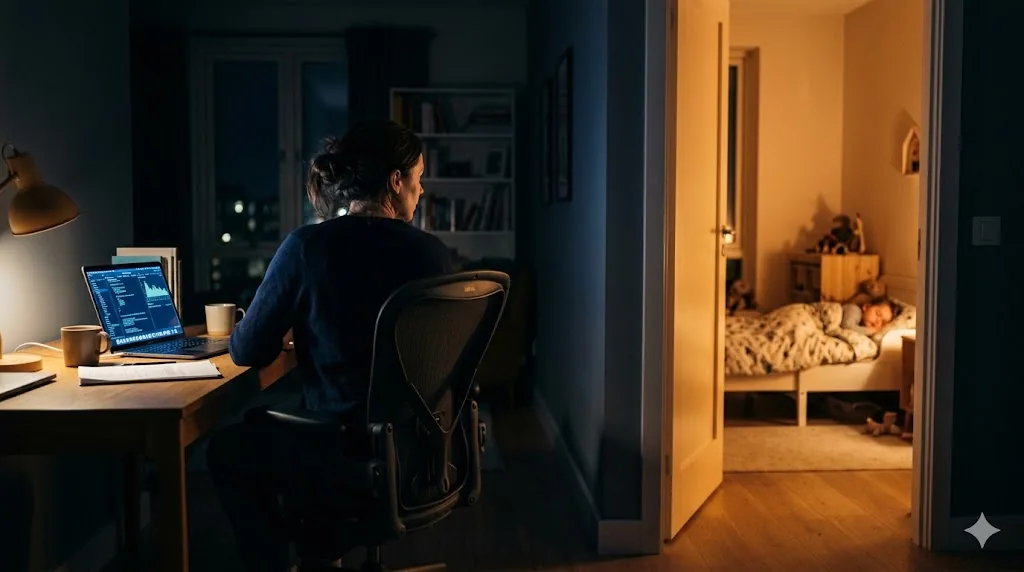
- We say we work for our families. But the providing keeps us from them.
- AI efficiency gains are not going home. Workers in AI-exposed roles are working more, not less.
- People are outsourcing feelings, not just tasks. AI is being used to handle conflicts, apologies, and emotional moments.
- Automation is only valuable if the time it reclaims goes somewhere that matters.
- Presence is love. Productivity is not.
Last week, I stood at a wake for a child who will never grow up.
She was close in age to my own daughter. It was the school holidays. Her family was doing what families do: spending time together at a chalet. She was playing at one of those outdoor exercise stations, the kind you see at every HDB estate in Singapore. The ones with the leg-swinging bars, the pull-up frames, the sit-up benches. She was playing. One wrong move. A split second of distraction. The sound of a temple hitting a metal pole. A scream. Then silence.
I will not say more about what happened, because this is not my story to tell. But I will tell you what it did to me.
I looked at her face and saw my daughter’s.
And the only question I could hold in my head, standing in that room, was this: if it were me, would I have spent enough time with her? Or would I have spent it working?
We Work to Provide. Then We Disappear.
Ask anyone why they work so hard and the answer is almost always the same: “For my family.” We say it like a reflex. For my kids. For my spouse. For a better life. We work so that the people we love can have what they need.
But here is the thing nobody says out loud. The people we work for are waiting at home. And most of the time, we are not there.
This is not a new tension. Long before AI entered the picture, we were already trading presence for productivity. A longitudinal study of dual-earner couples found that higher work hours led to lower relationship satisfaction, not just for the person working, but for their partner too. Research on working parents tells the same story: missed milestones with children, reduced couple time, and a guilt that never quite goes away.
Bronnie Ware, a palliative care worker who spent years with people in their final weeks, documented the five most common regrets of the dying. Number two on the list: “I wish I hadn’t worked so hard.” Number four: “I wish I had stayed in touch with my friends.” The people at the end of their lives were not wishing for a bigger title or a higher bonus. They were wishing for the people they had let go of along the way.
A 2024 systematic review on life regrets and well-being confirmed what Ware observed anecdotally: regrets related to relationships and authenticity are among the most psychologically potent. They don’t fade with time. They compound.
And now, AI is accelerating the pattern.
AI Was Supposed to Give Us Time Back. It Didn’t.
The promise of AI was efficiency. Automate the routine. Eliminate the busywork. Free up time for what matters.
The data tells a different story. A St. Louis Federal Reserve study found that generative AI users saved an average of 5.4% of their work hours, roughly 2.2 hours per week. A Freshworks report put the figure even higher: 3 hours and 47 minutes saved per week, equivalent to 24 business days per year.
So where did the time go?
Research tracking AI-exposed occupations from 2004 to 2023 found that workers in roles more exposed to AI actually increased their weekly hours relative to less exposed workers, by about 2.2 additional hours per week. They also spent less time on socialising and leisure. The authors describe AI as functioning more as a “coping” mechanism to keep up with rising workloads than as a labour-saving device.
AI made people more productive. And they used that productivity to work more, not to live more.
The efficiency gains did not go home. They went back into the machine.
We’re Not Just Outsourcing Tasks. We’re Outsourcing Our Feelings.
Here is where it gets uncomfortable.
A leadership coach I had dinner with last week shared something that stopped me mid-bite. She had a confrontation with a friend. When the friend responded, she could tell immediately it was written by AI.
People are using AI to do a lot of the human communication that they usually have to sit with and express what they really feel. And they don’t like being called out on it.
A global leadership coach and facilitator
When she replied asking if the response was AI-generated, her friend became defensive. Not about the conflict itself, but about being caught using a machine to handle a human moment.
This is not an isolated incident. A Kantar Profiles global survey found that 54% of consumers have used AI for at least one emotional or mental well-being purpose. According to a Resume.org survey, 7 in 10 Gen Z workers now use AI to navigate workplace conflicts. We are outsourcing not just our spreadsheets but our feelings.
The same coach recalled an art exhibition where young people were asked to post their biggest fears in life. The answers were not about exams or career pressure. They were about having to speak to a human being in a job interview. The fear was not failure. The fear was face-to-face connection.
But the messiness of human relationships is the point. It is how we learn to care. It is how we stay human.
What Standing at That Wake Taught Me
I keep coming back to the exercise station. A neighbourhood fixture. Completely ordinary. Every HDB estate has one. Kids play on them every day. No one thinks twice.
One split second. That is all it took. And a family’s world ended.
There is no lesson grand enough for that kind of loss. I would not dare try to extract meaning from someone else’s worst nightmare. But I can tell you what it did to the rest of us standing in that room.
It stripped everything back.
Every deadline. Every client deliverable. Every ambitious goal I have been chasing. None of it mattered in that room. The only thing that mattered was who you had beside you and whether you had been present with them.
I thought about my own daughter. Are the hours I spend building this business hours I am giving to her future, or hours I am taking from her childhood? Is the work I do “for her” actually keeping me from her?
The answer, if I am honest, is both. And that is the tension I do not think we talk about enough.
Why I Automate Everything I Can
I run a two-person consultancy. AI agents handle my research, outbound, content scheduling, programme design support, and CRM. If it can be automated, it is automated.
But here is what most people get wrong about why I do it.
I do not automate to produce more. I automate to be home.
The time I reclaim from automation does not go back into the business. It goes to my family. It goes to being physically present when my daughter wants to show me something. Years ago, I left a job with no backup plan because I realised I was earning money to keep my dog alive while spending none of that life with her. The pattern was already there. The wake just made it impossible to ignore.
We work to provide for the people we love. But the providing takes us away from them. And we never question it because we have convinced ourselves that productivity is love.
It is not.
Presence is love. And presence requires time. And time is the one thing most of us have given entirely to work.
The Antidote Is Not Another Tool. It’s Stillness.
When I asked the same leadership coach what people can do to stay human in an AI-saturated world, her answer had nothing to do with technology.
Give ourselves quiet, empty space. That can be the scariest thing for people in a stimulation-driven society. We become afraid of ourselves. But the thing that we’re most afraid of is to be without anything, only being.
A global leadership coach and facilitator
When I heard that, it hit me. Because I cannot do it. Every waking moment, I need some form of stimulation. Thinking about an article. Writing about work. Planning a process for a client. Or I am scrolling LinkedIn. Watching something on YouTube. My mind is always consuming, always producing. I have never just been still.
And then I tried it. I stood in the shower one morning. No thoughts about work. No mental to-do list. Just standing there. Still. Reconnecting with myself. And I felt something I had not felt in a long time. I felt present.
But we have built entire careers, entire identities, around never stopping. The same coach named a risk she sees in passionate entrepreneurs: “Purpose-led burnout. If you’re not careful, the meaning becomes the thing that burns you out.”
I felt that. I feel that. Running a business I believe in does not make me immune to the same trap. The work feels meaningful, so I let it take more than it should. And the people I am doing it for get what is left over.
Organisations Are Starting to Notice
There is a quiet shift happening inside some companies. Not all of them. Not most. But some.
More companies are talking about the need for extra humanness. Before, it was enough to ask ‘When do you want your next promotion?’ Now the conversations need to go deeper: ‘Where do you find meaning? What else could you do?’
A global leadership coach and facilitator
It is a strategic response to a workforce that is increasingly automated, increasingly anxious, and increasingly disconnected. When AI handles more of the routine, what is left for humans is the relational, the emotional, the deeply personal. And most organisations have spent decades training that out of people.
A World Economic Forum article noted that early AI adopters are experiencing weaker connections to co-workers and a lower sense of productivity, despite measurable output gains. The efficiency is real. But so is the isolation.
This is the paradox. AI gives us more output but less connection. More productivity but less presence. More time on paper but less time where it counts.
Unless we choose differently.
Who Are You Working For?
If you have made it this far, I would like to invite you to try something. Not a framework. Not a three-step model. Just a question.
Tonight, when you finish work, before you check one more email or clear one more task, ask yourself: who am I working for?
If the answer is a company name, a job title, or a KPI, that is fine. But then ask the follow-up: and who am I working for?
The answer to the second question is probably sitting in the next room. Or sleeping in a small bed down the hall.
They are not waiting for your promotion. They are not waiting for your next big project to ship. They are not waiting for you to finally “make it.”
They are just waiting for you.
I cannot bring back the girl I stood over at the wake. I cannot give back the time I have already traded.
But I can choose what I do with tomorrow.
And so can you.